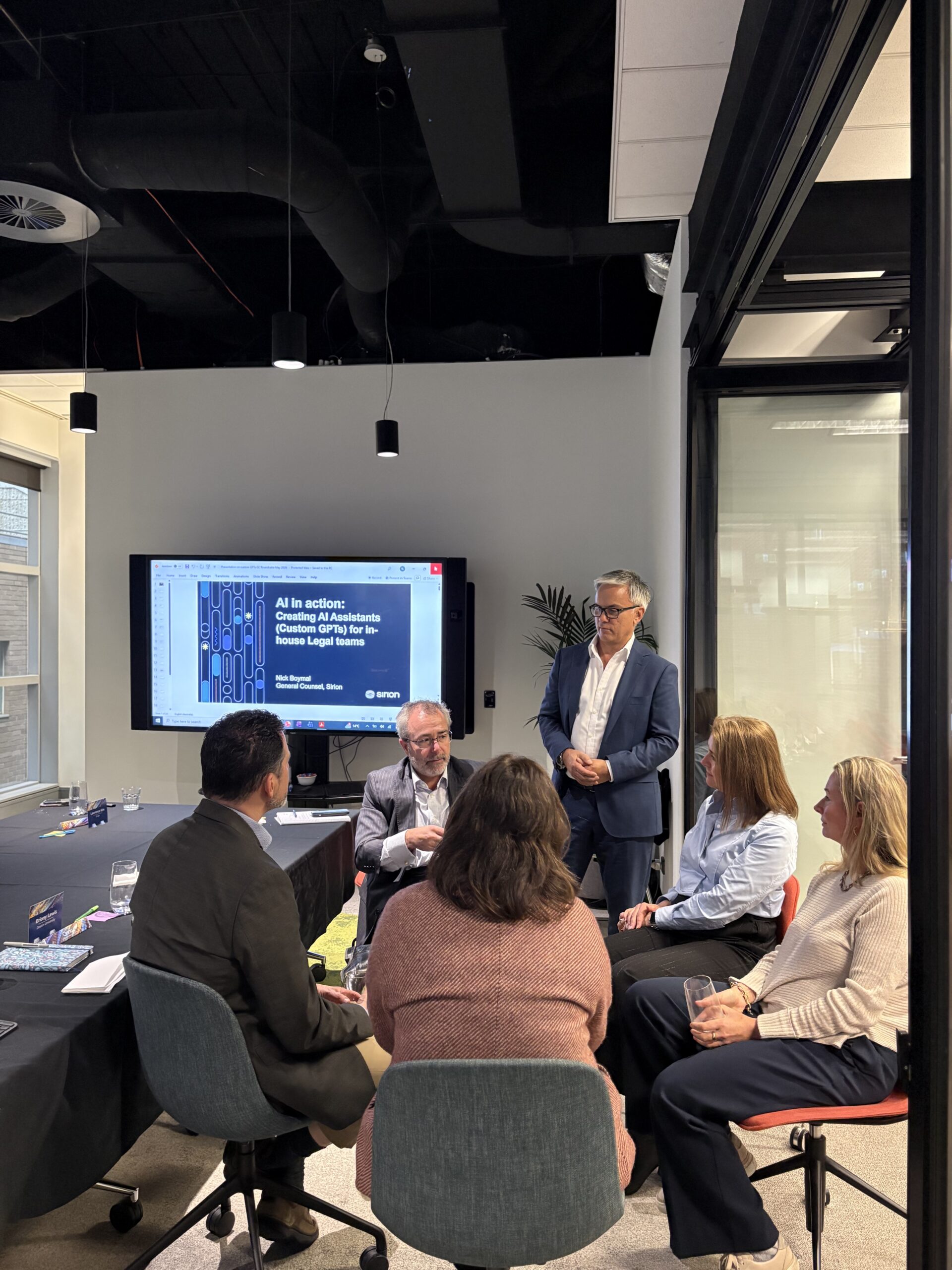

Artificial intelligence continues to dominate conversations across the legal industry, but many in-house teams are still asking the same question: what does practical adoption actually look like?
At Clario’s recent In-House Legal AI Webinar, attended by almost 70 legal leaders from across Australia, two General Counsel shared real-world examples of how their teams are already using AI to improve productivity, reduce costs and increase capacity.
Rather than focusing on theory, both speakers demonstrated tools currently being used within their organisations to solve everyday legal challenges.
Building custom legal AI agents in minutes
Nick Boymal, General Counsel at Sirion, demonstrated how his team has developed a suite of custom GPT-powered legal agents designed to support common legal workflows.
These tools were built quickly using existing AI platforms and internal reference materials, allowing the legal team to create practical solutions without specialist technical expertise.
Examples included:- Playbook Assistant: A GPT trained on Sirion’s contracting playbook that provides instant guidance on negotiation positions and drafting approaches.
- Patent Pre-Screening Agent: A tool that reviews employee invention submissions and assesses which opportunities warrant external patent review, helping reduce unnecessary external legal spend.
- SaaS Terms Comparison Agent: An AI assistant that compares company terms against competitor agreements and generates clear comparison tables in seconds.
- Legal Data Analyst: A GPT capable of transforming legal workflow data into visual reports, charts and actionable insights.
One of the most striking takeaways was the speed of implementation. Nick explained that a team of five lawyers was able to create four fully functioning legal agents within a week.
Importantly, he noted that accuracy improved significantly when the GPTs were restricted to approved internal reference materials, highlighting the importance of quality inputs and governance.
AI as a practical legal workspace
Ashley Kerr, General Counsel at BetCloud, provided a live demonstration of Google’s Gemini platform and its ability to generate legal and commercial documentation in real time.
Using an AI workspace populated with company governing documents, Ashley demonstrated how Gemini could quickly produce:
- Vesting notices and exercise notices.
- Director resolutions and invitation letters.
- Executive summaries.
- Full project scopes (including costs, risks and dependencies).
The demonstration showcased how AI can accelerate document creation while maintaining consistency with existing corporate documentation.
One particularly compelling example involved generating a complete suite of employee share scheme documents and supporting project materials in approximately 20 minutes.
Ashley also highlighted the flexibility of modern AI tools, which can instantly adapt tone, format and level of detail to suit different audiences and use cases.
Perhaps most notably, he explained that the productivity gains delivered through AI had materially increased the capacity of his legal function, reducing the immediate need for additional legal headcount.
Common themes emerging across in-house legal teams
While the technologies demonstrated differed, several consistent themes emerged from both presentations.
- AI is delivering value today: AI is no longer a future consideration for legal teams. Organisations are already using these tools to improve productivity, accelerate drafting and enhance decision-making.
- Technical skills are not required: Both speakers emphasised that building useful AI tools no longer requires coding expertise. Lawyers can create highly effective solutions simply by combining quality prompts with trusted internal documents.
- Human oversight remains essential: Despite the impressive capabilities demonstrated, neither speaker advocated for fully automated legal decision-making. AI can accelerate research, drafting and analysis, but legal judgement, risk assessment and commercial nuance remain firmly human responsibilities.
- Cost reduction opportunities are significant: By improving first drafts, streamlining routine work and supporting better matter scoping, AI has the potential to reduce reliance on external counsel for many early-stage tasks.
- Governance and confidentiality matter: Both presenters stressed the importance of using enterprise-grade AI solutions and maintaining appropriate controls around confidential and personal information. As adoption increases, governance frameworks will become just as important as the technology itself.
The opportunity for in-house legal teams
The webinar demonstrated that successful AI adoption is not about replacing lawyers. It is about enabling legal teams to focus more of their time on strategic, high-value work.
For many in-house teams, the most effective starting point may be identifying repetitive tasks, standardised workflows or information-heavy processes that can be supported by AI tools.
The technology is increasingly accessible. The challenge is no longer whether AI can be used in legal functions, but how organisations can implement it safely and effectively.